How to Set Up Your Mirrors Before a Drive
Set your mirrors from your normal driving position, check how they work with your vehicle, and use direct observation before moving into a space.
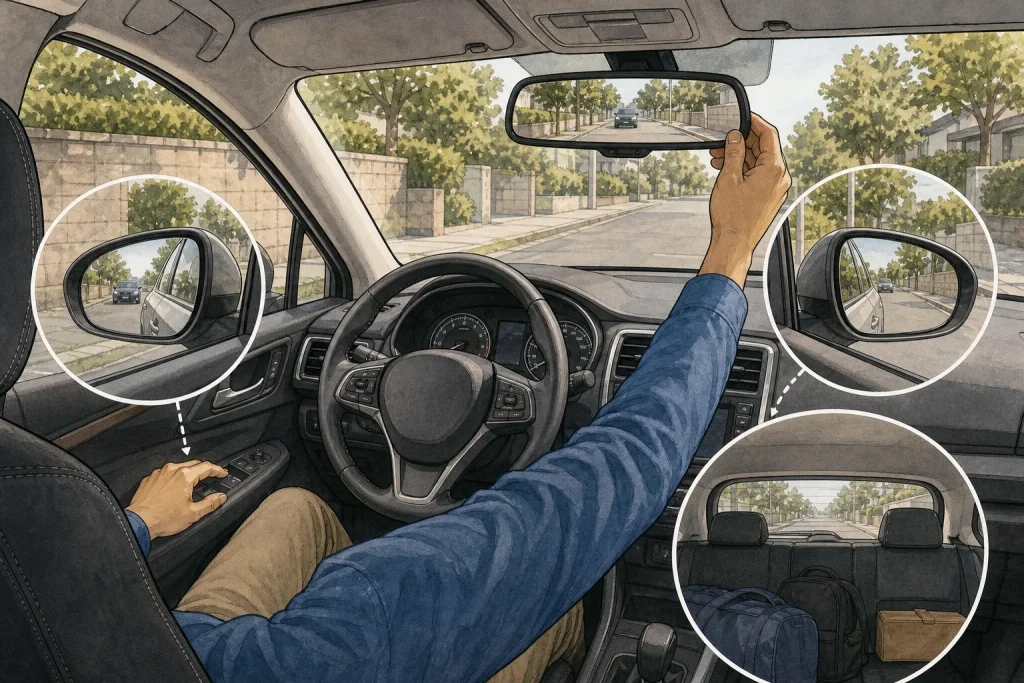
Before pulling away from a curb, settle into your normal driving position and check the mirrors. If the seat is reclined from a passenger’s ride or the steering wheel has moved, the reflections may no longer show the areas you expect. A brief, consistent setup helps you gather information about traffic around the car, but no mirror replaces a direct look.
Set your driving position first
Adjust the seat before the mirrors. Sit back against the seat, place your feet comfortably at the pedals, and set the seatback and steering wheel so you can steer without stretching. Keep the road and dashboard in view. Make sure you can turn your head and shoulders enough to look over each shoulder. Mirror settings depend on where your eyes are, so changing your seat afterward changes the picture.
Make adjustments while parked safely. If you are on a street, choose a legal, secure place and keep the vehicle stationary. A parked car, wall, or other fixed object can help you orient yourself, but one nearby object cannot confirm that the whole area is visible. Aim for a useful view of the roadway beside and behind you, not a perfectly symmetrical reflection.
Frame the rear window in the interior mirror
Adjust the interior mirror to show as much of the rear window as practical. Keep your head in its normal driving position and move the mirror rather than leaning toward it. You want a quick view of the road behind you without a head restraint or cargo blocking the reflection.
If passengers or luggage obstruct the rear window, the interior mirror may be less useful. Do not change your posture or stare at it to compensate. Reposition or secure cargo where practical, and use the side mirrors for the areas they show. If your vehicle has camera views, learn their controls and limitations from the owner’s manual; treat the displays as aids, not replacements for observation.
Adjust side mirrors for your vehicle
Use the owner’s manual and any mirror markings or warnings as your starting point. Mirror designs and viewing angles differ, so there is no single outward angle that suits every car or driver. From your normal seating position, adjust each side mirror to give you a useful view of the roadway alongside and behind the vehicle, while retaining enough reference to understand where the car is in the reflection. Avoid relying on a prescribed handoff from one mirror to another: the visible areas can overlap or leave a gap.
Some mirrors are convex and show a wider area, but objects may appear smaller or farther away than they are. Check for a warning etched into the glass and take the mirror’s shape into account. Use reflections to notice traffic and its movement; do not judge distance from apparent size alone.
Adjust the passenger-side mirror from the driver’s seat, using the controls as intended. Leaning across the cabin to set it from a different position can change the view once you return to the wheel. If another person drives the car, have them set the mirrors for their own seating position before moving off.
Learn the limits of each view
Once the mirrors are set, notice how traffic appears in each reflection. A vehicle may be visible in more than one mirror, or it may disappear from one view before appearing in another. The pattern depends on the vehicle, mirror adjustment, and road position. Treat any uncertain area as one that needs a direct check before you move into it.
You can review the reflections while parked using a safe, stationary reference, or notice them during a later drive without attempting a lane change. Do not lean or twist while driving to make a mirror view work. If a mirror needs correction, pull over safely first.
Pair mirror checks with direct observation
Mirrors cannot show every area beside or behind the car. A vehicle may be hidden by a pillar, fall outside a mirror’s view, or enter a blind area between glances. Before changing lanes, merging, pulling away from the curb, or turning across a path, check the relevant mirrors and make a brief direct glance toward the area when appropriate. Keep the glance short enough to maintain awareness of the road ahead.
Adapt your checks to the maneuver. Before changing lanes, scan ahead, check the interior and relevant side mirror, signal as required, and look directly toward the space you intend to enter before moving. Reassess if traffic changes while you prepare. A signal communicates an intention; it does not show that the space is clear.
On a bend, steep driveway, or crowded parking area, reflections can shift quickly. Use brief, purposeful glances and look directly where the vehicle is going. When reversing, check available views and look behind you as conditions allow. Do not assume a mirror or camera shows every person or object. Follow the vehicle manual and local rules for camera systems and driver aids.
Recheck when the view or conditions change
Review the setup after moving the seat, changing drivers, loading cargo, or knocking a mirror. A passenger’s head may block part of the rear window, and luggage may cover its lower portion. If an obstruction can be moved or secured safely, do so while parked. If you still cannot see well enough to drive safely, stop in a suitable place and address the problem before continuing.
Glare, darkness, rain, and dirt can also affect what you see. If the interior mirror has an anti-glare setting, use it as directed in the manual and confirm that the view remains usable. Clean dirty side mirrors while parked, not while moving.
Hypothetical example: sharing a family car
Imagine Sam borrowing a family hatchback after another driver used it. Sam’s seat is farther forward than the previous driver’s, the interior mirror points toward the ceiling, and the driver’s side mirror shows a broad strip of the car door. Sam’s starting point is a parked, secure car; the decision is to adjust everything before setting off.
Sam first adjusts the seat and steering wheel, then frames the rear window from the normal driving posture. Sam consults the manual for the side mirrors and adjusts them from the driver’s seat to show a useful view of the adjacent roadway. While stationary, Sam checks what fixed objects are visible in each reflection, without treating that as proof that every area is covered. On a later drive, Sam notices where traffic appears and disappears in the mirrors, but does not use that observation to begin a maneuver without a direct check.
The expected result is a view suited to Sam’s seating position and a clearer sense of where direct observation is needed. If a mirror will not adjust, the glass is damaged, or an important view remains obstructed, Sam delays the trip and asks the vehicle owner or a qualified repair professional for help.
Keep the routine consistent
Use a simple sequence: settle into your driving position, frame the rear window, adjust the side mirrors according to the vehicle guidance, and stay alert to the limits of each view. Repeat the setup after another driver uses the car or the seat position changes. Before acting on information from a mirror, confirm critical spaces with direct observation.
A direct glance does not mean the mirrors were set badly. It is part of using them well: mirrors help you notice nearby traffic, while your eyes and attention complete the check.
Keep exploring

Why Cars Become Part of a Neighborhood’s Identity
A neighborhood’s relationship with driving grows from ordinary routines: where people park, what they carry, and…
What Your Car’s Dashboard Symbols Are Trying to Tell You
When an unfamiliar light appears, put safe driving first, then use the exact vehicle manual and…